
LED Battens, Strips or Panels: Choosing Garage Light Fittings
You have decided to sort out your garage lighting, then you look at the options and it is a wall of jargon. Battens, strips, panels, lumens, IP ratings. Which one actually belongs in a garage? The good news is the choice is simpler than it looks once you know what each type does. Here is a plain English guide to picking the right garage light fittings.
Key Takeaways
- LED battens are the best all round fitting for most garages.
- Panels suit flat ceilings, strips are for task and accent light, not the main source.
- Match the IP rating to how damp your garage gets, IP65 for damp spaces.
- Three or four battens light most single garages, judged by lumens not watts.
Why LED Is the Only Sensible Choice Now
Old fluorescent tubes used to be the default in garages. They flicker, hum, and struggle to start in the cold, which is exactly what a UK garage throws at them.
LED fittings have replaced them for good reason. They switch on instantly even at low temperatures, use far less power, and last for years without attention.
Whatever fitting style you choose, make sure it is LED. Everything below assumes that, because nothing else makes sense in a modern garage.
LED Battens: The Garage Workhorse
An LED batten is a long, slim fitting that surface mounts to the ceiling. It is the most popular choice for garages, and for good reason.
Battens are bright, even, and cheap. A few of them spread across the ceiling give clean, shadow free light across the whole space.
They are the safe default for most garages. If you are not sure what to pick, a row of LED battens will rarely be the wrong answer. They fit straight onto a bare joist or a finished ceiling with no special preparation.
LED Panels: Clean and Even
LED panels are flat, square or rectangular fittings that give a very even spread of light. They look tidy and modern.
They suit garages that have a suspended or plasterboard ceiling where the panel can sit flush. In a bare garage with exposed joists they are less practical than battens.
Panels are a good shout if your garage doubles as a home office, gym, or hobby room and you want a cleaner finish overhead. They cost a little more than battens but give a more finished look.
LED Strip Lighting: For Detail and Accent
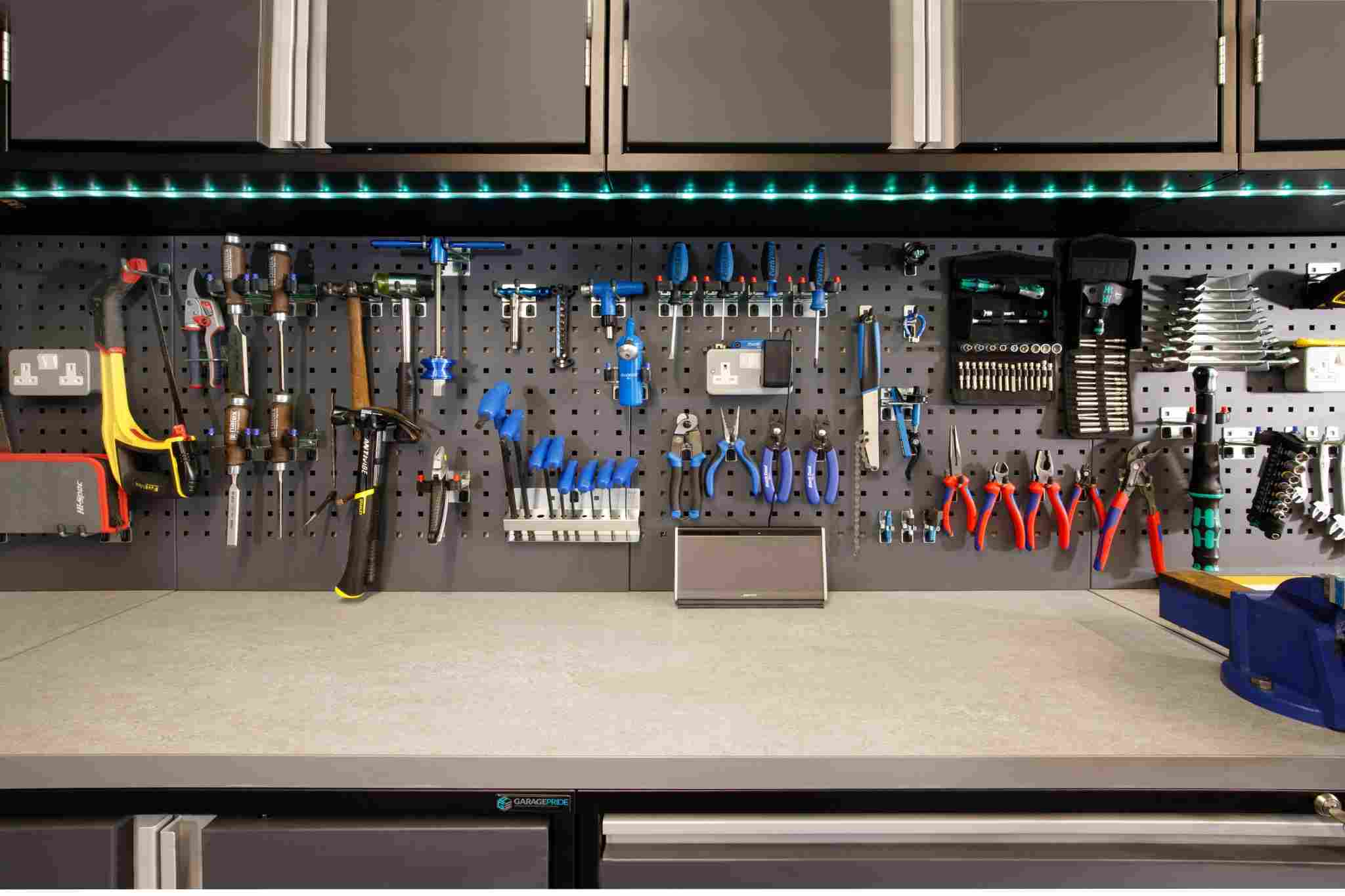
LED strips are thin, flexible runs of light you can fix under shelves, along a workbench, or around the edge of the ceiling.
They are not a replacement for proper overhead lighting. Their job is to fill in the shadows that bigger fittings miss.
A strip under a wall shelf or above the workbench lights the surface directly, which is exactly where you need it when working with your hands. Use them to add detail light, not as the main source.
Understanding Lumens and Wattage
When you buy a fitting, look at the lumens, not the watts. Lumens measure the light you get, while watts only measure the power it uses.
A modern LED batten gives a lot of light for very few watts, which is the whole point. An old habit of buying by wattage will leave you with the wrong fitting.
As a rule, a 5ft LED batten puts out around 2,000 to 2,500 lumens. Add up the lumens of your fittings and aim for roughly 7,500 to 9,000 in a single garage.
Understanding IP Ratings
An IP rating tells you how well a fitting resists dust and moisture. Garages get colder, dustier, and damper than the rest of the house, so this matters.
For a normal dry garage, IP20 fittings are usually fine. If your garage suffers from damp, condensation, or the odd leak, step up to IP65, which is sealed against dust and water jets.
If you are tackling damp at the same time, it is worth sorting ventilation and keeping moisture down before you fit electrics. A sealed fitting lasts far longer in a humid garage.
How Many Fittings Do You Need?
Work backwards from the brightness you are aiming for. A standard UK single garage needs roughly 7,500 to 9,000 lumens of general light.
A typical 5ft LED batten puts out around 2,000 to 2,500 lumens. So three or four battens evenly spaced will light most single garages well.
For the full breakdown of brightness by garage size, see our guide on how much light a garage actually needs.
Where to Position Your Fittings
Spacing matters as much as the number of fittings. Spread them evenly across the ceiling so the light overlaps and there are no dark patches.
Run battens along the length of the garage rather than across it, so the light follows the way you move and park.
Then add a dedicated fitting or strip directly over the workbench, since that is where you need the most light for detailed work. Lighting the middle alone always leaves the edges dark.
Common Fitting Mistakes
The biggest mistake is buying one big fitting instead of several smaller ones. Spreading the light out kills shadows and lights the corners.
Another is ignoring the IP rating in a damp garage. A cheap indoor fitting will not last long in a cold, humid space.
Lastly, do not mix warm and cool bulbs. Stick to one cool white colour temperature across all fittings for a clean, consistent look.
FAQ: Garage Light Fittings
- What is the best type of light for a garage? LED battens are the best all round choice. They are bright, even, affordable, and easy to fit across a ceiling for shadow free light.
- What IP rating do I need for garage lights? IP20 is fine for a dry garage. For a damp or unheated garage, choose IP65 fittings that are sealed against dust and moisture.
- Can I fit garage lights myself? Simple plug in or existing fitting swaps are straightforward. Any new wiring or circuits should be done by a qualified electrician.
- Are LED panels better than battens? Panels look tidier on a flat ceiling, but battens are cheaper and easier to fit in a standard garage with exposed joists.
- How many battens do I need in a single garage? Three or four 5ft LED battens spread evenly across the ceiling will light most single garages well.
Conclusion
Choosing garage light fittings comes down to a few simple choices. Go LED, pick battens for most garages, add strips for detail, and match the IP rating to how damp your space gets.
Get those right and you will have bright, even, reliable light for years.
Browse our garage lighting range to find fittings built for UK garage conditions.
Related GaragePride Guides
Share Story


